This content has been reconfigured to give all users the experience of being hindered when accessing information. Please be aware that it will be purposefully inconvenient to read content while turning the page.


This content has been reconfigured to give all users the experience of being hindered when accessing information. Please be aware that it will be purposefully inconvenient to read content while turning the page.



Nearly all information of the 21st century is formed and propagated with the help of the Internet infrastructure. To alleviate users’ isolation from information, which is known as the ‘Digital Gap’, the importance of information accessibility design has been on the rise.
What would be the essential element of a design that takes the accessibility of all users into consideration?
We believe it is about ‘empathizing with the senses of those in the minority’. Through this story, we will witness what it is like to be in the shoes of the minority and
experience the solution for accessing minimum
information available in the digital world.
Imagine a world of complete darkness.
Imagine a world where light has vanished.
In this world, how would we recognize objects and
communicate with others?
Travelers in the dark light
their path using other senses.
 Someone is
listening
carefully.


Someone is
reaching out
their hand.

Someone is
touching and
feeling
the bumps
of braille.
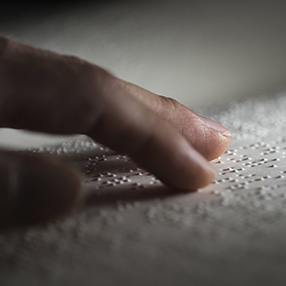
Among your five senses, the sense of vision accounts for nearly 70%. However, even without the sense of vision, we still have the sense of hearing and touch. Information can be acquired with our hands through braille, and images can be transcribed into texts and be heard as spoken words.
Just because you can ‘see’ something doesn’t mean
you will ‘understand’ it. Likewise, simply being able
to see doesn’t guarantee access to clear information.
Some people might find certain text to be fuzzy or
dim to properly see it, and others may have trouble
recognizing objects within visible range.

We enlarge texts for better readability.

We brighten the dark background for better visibility.
Regardless of suffering from low vision or other visual impairments, everyone will eventually grow old, and their vision will wither. Therefore, the information accessibility solution of providing large, clear texts and heightening the brightness of information respective to the background screen is a design made for just about anyone.
Colors are the building blocks of design,
and through it we enrich the world. However,
just because you can’t see color doesn’t mean
you are far from information.
We can create and
understand
information
just by adhering
to the
4.5:1 ratio
for brightness.
Around 1.5 million people in Korea, and close to 200 million people around the world cannot recognize a specific color or have trouble with interpreting different colors. Eliminating a person’s right to information for the purpose of designing beauty is not a beautiful gesture. We must design with the intention of enabling anyone to easily access and experience information.
The easiest way to execute applications or
perform tasks on the mobile is through ‘touch’.
However, it is sometimes difficult to touch
the same area continuously, or precisely touch on
a specific spot.
Even the easiest movements must be further minimized.

We should be able to move on to the next page using only a simple stroke. Just as peoples’ creation of information is never-ending, one’s accessibility must also be easy and everlasting.
Designers at Samsung Electronics are also making the utmost effort to understand and empathize with all our users to consider the depths, widths, and varieties of our users’ experiences. Our products and services may have been created by developers and designers, but the true experts of using these creations are none other than our individual users.